















November 2026 | Traceability, Serialization and Grey Market
40,000 Suspected Counterfeits Intercepted in Hong Kong: Keeping Product Identity Verifiable Across Borders
When we think about where counterfeits are found, we usually think of the end of the chain: a market stall, an online shop, a store shelf. A recent enforcement operation in Hong Kong is a reminder that counterfeit products also travel – often a long way – before they reach anyone.
In late October 2026, Hong Kong Customs reported the results of a coordinated enforcement operation with customs authorities from mainland China and Macau. The operation targeted suspected counterfeit products moving through international logistics and transshipment channels. Authorities identified 13 cases involving approximately 40,000 suspected counterfeit products with an estimated market value of HK$9 million.
The seized goods included watches, mobile phones, handbags, eyewear and footwear. The operation focused on shipments destined for markets in the Americas, Europe, the Middle East, Africa and Southeast Asia.
Why transit is a blind spot for brand owners
Five destination regions from one operation. That detail says a lot. Counterfeit products frequently move through multiple logistics providers and jurisdictions before they reach their destination.
For brand owners, these routes make it difficult to determine where suspicious products originated or where they entered the supply chain. By the time a fake turns up in a shop in one country, it may have passed through several others. And without information about the product itself, there is little to connect the dots.
This is the core challenge: a product’s identity should remain verifiable even after it leaves the manufacturer’s control.
From product to data point
Physical inspection by customs remains essential. But brand owners can add a layer of their own: product identities that can be verified anywhere, and that generate information every time they are checked.
When each genuine product carries a unique identity and verification events are recorded, manufacturers gain visibility into where their products – and suspected copies – actually appear. Unusual geographic activity, or the repeated use of the same identity, can become visible.
These signals can support investigations into counterfeiting and unauthorized distribution. They are not, by themselves, proof of illegal activity. But they turn scattered incidents into patterns that can be investigated.
What brand owners can build into their products
Verification data is only meaningful if you know what “normal” looks like. That is why the starting point is not technology but knowledge of your own distribution: which product lines are intended for which markets, and which partners serve them. This becomes the reference against which unusual activity stands out.
The second element is a product identity that travels with the product. A unique identifier (UID) – unique and not predictable – distinguishes one individual item from every other. Encoded in a QR code, a hidden code or an NFC tag, it can be verified in any market. Because such identifiers cannot simply be guessed, a copied code becomes visible as soon as the same identity appears in more than one place.
An identity is only as reliable as its connection to the product. Our tamper-evident SecurityLabels are designed to show visible traces such as a VOID effect when someone tries to remove them, so a genuine label cannot simply be transferred to another product without leaving evidence. Holograms and security inks make the label itself harder to copy.
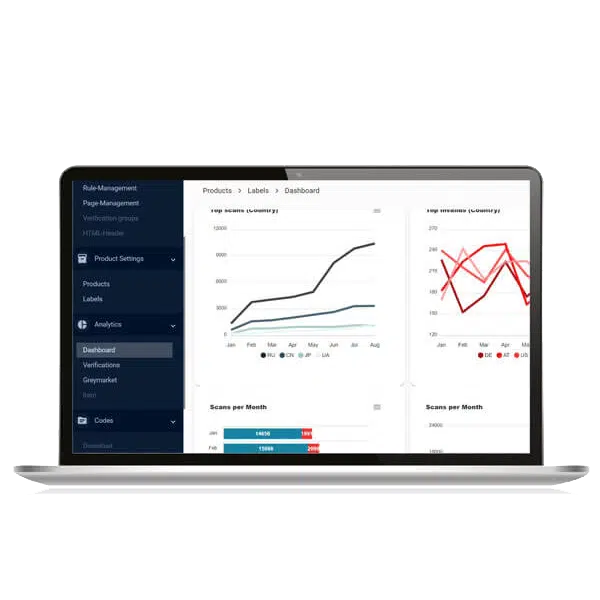
Finally, the data has to come together. With CODIKETT, our cloud-based platform, verifications by consumers, retailers, distributors or inspectors can be recorded and analyzed over time. Scans in markets where a product was never supposed to go, or repeated scans of the same identity, stand out. Shared with brand-protection teams, legal advisors or enforcement partners and combined with distributor records, these signals help you ask the right questions sooner. They do not replace customs work – they complement it.
Visibility beyond the factory gate
The Hong Kong operation shows how international counterfeit flows can be. No brand owner can follow every shipment. But every brand owner can make sure that their genuine products carry an identity that stays verifiable – wherever in the world the product ends up.
If you would like to explore how product identities and digital verification could support your brand protection, we are happy to talk. Learn more about secure UID issuance or request free sample labels for your requirements.
FAQ
Transshipment means goods are moved through an intermediate location on their way to the final destination. Counterfeit products may pass through several logistics providers and jurisdictions this way. This makes it harder for brand owners to determine where suspicious products originated or entered the supply chain.
By giving each product a unique, verifiable identity and recording verification events, brand owners can see where products are checked. This provides visibility into product movements across markets. Combined with knowledge of intended distribution routes, it helps identify unusual activity.
Start by documenting your intended distribution routes and identifying the products most exposed to counterfeiting. Then consider unique identifiers combined with tamper-evident labels and digital verification. Our team can help you choose suitable features and provide free sample labels for testing.