
















October 2026 | Traceability, Serialization and Grey Market
What the Hong Kong Customs case teaches brand owners about protecting product identity
When we talk about counterfeiting, most people picture a fake: a copied handbag, an imitation perfume, a pill that only looks like the real thing. But a recent case in Hong Kong points to a quieter and in many ways more difficult problem. The product was real. Its identity was not.
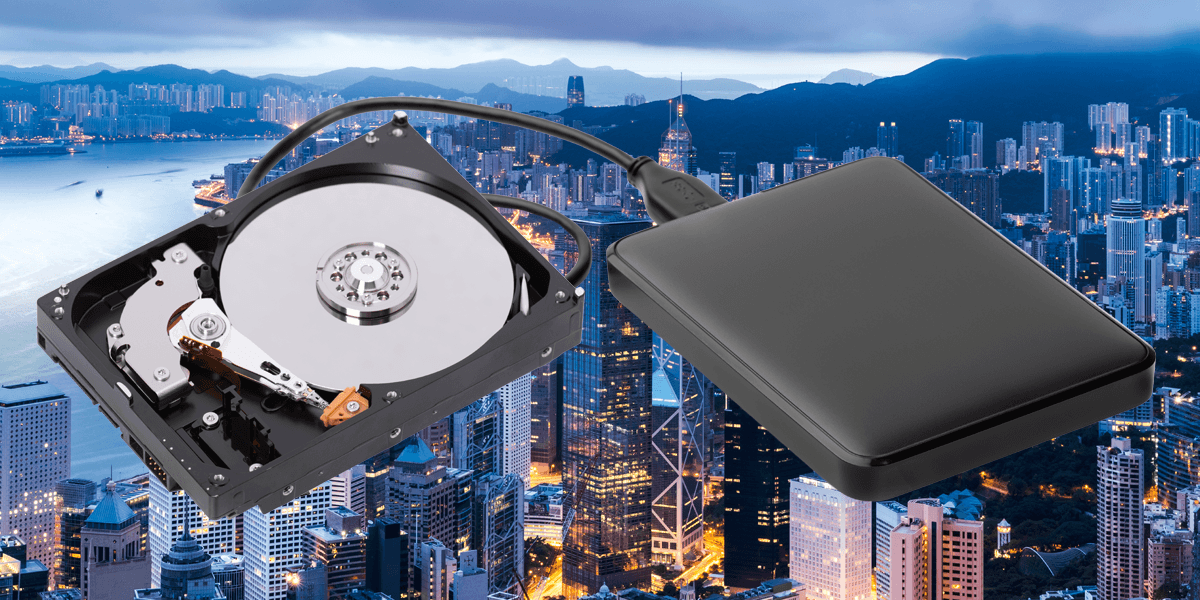
In mid-October 2026, Hong Kong Customs uncovered suspected counterfeit hard-drive processing operations in five industrial units. Authorities seized approximately 6,800 suspected counterfeit hard drives with an estimated market value of HK$50 million, and found around 20,000 second-hand hard drives believed to be awaiting processing. Six people were arrested, and investigations are ongoing.
What makes this case so instructive is not its size. It is the method investigators described.
How the suspected relabeling operation in Hong Kong worked
According to investigators, the suspected operation followed four steps. Original labels were removed using adhesive removers. The drives were electronically formatted. Labels of major brands were applied. Finally, the products were sealed in anti-static packaging.
Look closely at that sequence and you will notice something: none of these steps requires copying a product. The hard drives were physical, working devices. What changed was everything that tells a buyer what they are holding – the brand, and with it the claimed condition, origin and value.
In other words, the label was the weak point. If an identification label can be peeled off with a solvent and replaced with a convincing new one, a used product can be presented as something different and more valuable – without leaving obvious evidence behind.
Why product identity is a security problem, not just a labeling detail
For many manufacturers, the product label is treated as information: a part number, a serial number, a logo, perhaps a barcode. It is designed to be legible and durable. It is rarely designed to resist removal.
That is exactly where relabeling attacks start. The physical product may be authentic, but its claimed identity, condition or origin can be misleading. And because the device itself is real, conventional checks of the product’s look and feel may not reveal anything unusual.
This matters well beyond electronics. Any industry where products carry value through their identity faces the same question: spare parts and technical components, automotive parts, chemicals and lubricants, pharmaceuticals, cosmetics, wine and spirits. Wherever a label defines what a product is, someone can try to change that definition.
So the question we ask brand owners is simple: can your product identity be transferred without leaving evidence?
How to protect your product identity: a practical approach
Protecting a product identity is not about one single feature. It works best as a combination of physical and digital measures that complement each other. Here is how we approach it together with our customers.
Step 1: Map where your identity lives
Start by identifying every element that tells a buyer, a distributor or an inspector what the product is. That might be a type plate on a device, a serial-number label on a component, a closure seal on a carton, or a QR code on a bottle. Then ask for each one: what would happen if someone removed it, transferred it to another product or replaced it with a new one? Would anyone notice?
This exercise often shows that the most important identity carriers are also the easiest to manipulate.
Step 2: Make removal visible with tamper-evident labels
The first line of defense is physical. Tamper-evident labels are designed so that certain attempts to remove or manipulate them leave visible traces. With our SecurityLabels, for example, a VOID effect can appear when the label is peeled off, and the label is designed not to be reapplied without showing evidence of the attempt.
Security cuts, special adhesives and security inks can add further layers, and some features can even indicate exposure to water or heat. The goal is not to make manipulation impossible – no honest supplier can promise that – but to make certain attempts visible, so that a relabeled product no longer looks untouched.
This also addresses label harvesting, where genuine labels are removed from original products and reused on other goods.
Step 3: Give every product its own identity
A conventional label says what kind of product something is. A unique identifier says which product it is. When each item carries its own UID – unique and not predictable, for example encoded in a QR code, a hidden code or an NFC tag – a copied or transferred identity becomes much easier to question.
Combining the UID with a tamper-evident label strengthens the link between the identifier and the item it was applied to. Removing the label to reuse the identity elsewhere should leave evidence on the original product.
Step 4: Add digital authentication
A unique identity becomes truly useful when it can be checked. With CODIKETT, our cloud-based platform, product identities can be verified digitally – by consumers, by inspectors or by your own brand-protection team.
Digital verification also provides data. Patterns such as repeated authentication attempts for the same identifier, or scans in regions where a product was never shipped, can point to suspicious activity. These signals do not automatically prove counterfeiting, but they show you where to look more closely.
Step 5: Connect physical and digital security
The real strength lies in the combination. Physical security can make opening, removal or manipulation visible. Unique identities distinguish individual products from one another. Digital authentication helps determine whether an identity is valid. Traceability adds information about how products move through your distribution channels.
This phygital approach protects not just the product, but the connection between the product, its identity and the information associated with it.
What brand owners can do now
You do not need to redesign your entire packaging to start. A good first step is to review your highest-value or most frequently imitated products and test how easily their identification labels could be removed and replaced. If you can do it in your own lab with an adhesive remover, so can someone else.
From there, it makes sense to talk with specialists about which combination of features fits your product, your production line and your markets. Each industry and each company has its own challenges, and the right solution is usually tailor-made.
If someone replaced your product’s label tomorrow, how would you know? If the answer is unclear, we are happy to look at it with you. Explore our anti-tampering solutions or request free sample labels for your requirements.
FAQ
Product relabeling means removing a product’s original label and replacing it with a different one, often to change the product’s apparent brand, condition or value. In a recent Hong Kong case, investigators described used hard drives whose original labels were allegedly removed with adhesive removers and replaced with labels of major brands. The product itself may be genuine, but the identity presented to the buyer is not.
In classic counterfeiting, the product itself is a copy, which can sometimes be spotted through quality differences. With relabeling, the product is physically real and may work normally, so inspecting the product alone may not reveal anything. The manipulation lies in the label and the identity it claims, which is why the label itself needs protection.
Label harvesting is the practice of removing genuine labels from original products or packaging and reusing them on other goods. Because the label is authentic, it can lend a fake or substituted product credibility. Tamper-evident labels that are designed to be destroyed or to show a VOID effect when removed help make this practice visible.
A UID is a code that identifies one individual product item rather than a product type. It can be printed as a QR code, hidden in the label design or stored on an NFC or RFID tag. Secure UIDs should be unique and not predictable, so that they cannot simply be guessed or generated by counterfeiters.
Digital authentication is a strong tool, but on its own it does not prevent a valid code from being moved to another product. That is why we recommend combining it with tamper-evident labels: the physical layer makes removal visible, while the digital layer verifies the identity and reveals unusual scan patterns. Together they offer more protection than either measure alone.
Start by reviewing which products are most attractive to manipulators and how their identification labels are currently applied. Then test how easily those labels could be removed or replaced. Our team can help you select suitable security features and provide free sample labels for your industry so you can test them on your own products.