















November 2026 | Authentication
A £10 Perfume and Three Vanloads of Fakes in Lancashire: Why the Shop Is Not Proof of Authenticity
When people think of counterfeits, they often picture anonymous online sellers or containers arriving from overseas. A recent case in Lancashire, in the north of England, shows that fakes can just as easily sit on the shelf of an ordinary shop.
In October 2026, Trading Standards officers in Lancashire seized more than 3,000 counterfeit products with an estimated value of £60,000. The goods included clothing, footwear, perfumes, cosmetics and accessories bearing the names of internationally recognized brands.
How the case unfolded
The investigation began after information was provided by members of the public. An undercover Trading Standards officer then purchased a branded perfume for £10. The product was subsequently confirmed to be counterfeit.
On October 27, officers returned with police and seized three vanloads of suspected counterfeit merchandise. Trademark representatives examined samples and confirmed that they were illegal copies.
Why a normal shop creates trust – and why that is the problem
Many consumers assume that a product bought in a real store, from a person behind a counter, is more trustworthy than one ordered from an unknown website. This case shows the limits of that assumption. Counterfeit products are not limited to international shipments or anonymous online sellers; they can reach consumers through ordinary retail premises.
A familiar shopping environment does not guarantee that a product is genuine. And for consumers, a convincing bottle and box are hard to distinguish from the original without any reference to compare them with.
The case also shows how valuable attentive members of the public are. It started with tips from people who noticed something was not right. Giving consumers a reliable way to check products themselves strengthens exactly that kind of vigilance.
Why "it looks right" is not enough
Counterfeiters are skilled at copying what consumers see: logos, bottle shapes, colors, printed codes. That is why authenticity checks that rely only on visual inspection have limits. Even a barcode does not settle the question – it identifies a product type, not an individual item, and it can be printed onto a fake as easily as onto an original.
What brands need is a check that does not depend on the consumer knowing exactly what the original looks like.
Three questions every consumer should be able to answer
Instead of expecting consumers to recognize every detail of an original, brands can design their packaging so that it answers three simple questions – in the shop, before purchase, without expert knowledge.
Has this product been opened?
For perfumes and cosmetics, a tamper-evident closure label shows whether a pack has been opened. When someone tries to remove one of our SecurityLabels, a VOID or OPEN message can appear, and the pack cannot be inconspicuously reclosed. It is the simplest check there is, and it works at a glance.
Is this hard to copy?
Individual holograms, security inks and security cuts are much harder to reproduce than printed packaging. They work best in layers: some can be checked by consumers and shop staff, others only by trained inspectors or with special tools. A counterfeiter who copies the box still has to defeat the label.
Can I verify it myself?
A unique identifier – unique and not predictable – encoded in a QR code or an NFC tag on a SmartLabel lets consumers and retailers verify one specific product with a smartphone, right at the counter. The answer comes from the brand, not from the appearance of the bottle.
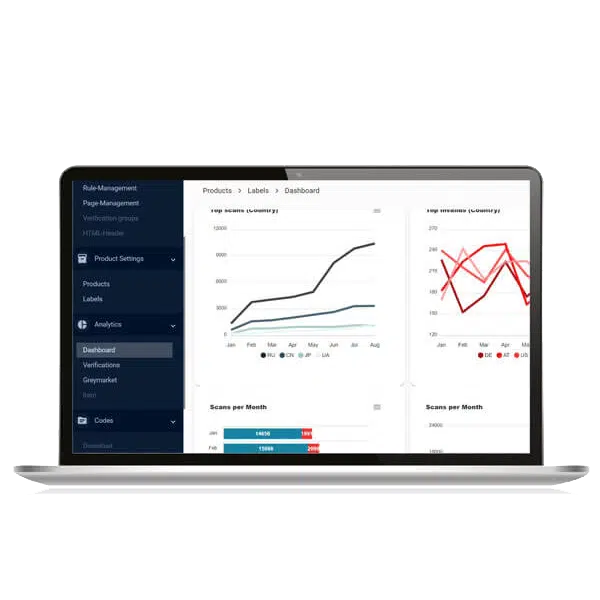
For brand owners, these verifications add a fourth benefit. With CODIKETT, our cloud-based platform, each check can provide information: if products are verified in shops outside your distribution network, or if the same identity is checked repeatedly, that is a signal worth following up. Such signals do not prove counterfeiting on their own – but like the public tips that started this case, they can point investigators in the right direction.
Giving consumers a way to be sure
Counterfeits on the high street undermine two kinds of trust: in the brand, and in the shop. Consumers should be able to trust the products they receive, wherever they buy them. Brands can support that by making authenticity something consumers can check for themselves, instead of something they have to assume.
If you would like to explore how product authentication could work for your brand, we are happy to help. Learn more about our anti-counterfeiting solutions or request free sample labels for your requirements.
FAQ
Yes. Counterfeit products are not limited to online sellers or international shipments; they can also reach consumers through ordinary retail premises. A familiar shopping environment does not guarantee that a product is genuine.
An unusually low price, missing or damaged seals and packaging that differs from the original can be warning signs. Buy from authorized retailers, check whether tamper-evident seals are intact, and use any verification code the brand provides. If in doubt, contact the brand directly.
A standard barcode identifies a product type, not an individual bottle, and counterfeiters can print it on fakes as easily as brands print it on originals. A barcode check therefore cannot prove authenticity. A unique, verifiable code issued by the manufacturer offers a far more reliable check.
Some brands put a unique code, often a QR code or NFC tag, on their products. Consumers scan it with a smartphone and the brand’s verification platform confirms whether the identity was issued by the manufacturer. The check works anywhere, including in the shop before purchase.
In the UK, you can report suspected counterfeit goods via the Citizens Advice consumer service, which passes reports on to Trading Standards. As this case shows, tips from members of the public can start an investigation. You can also inform the brand owner, who may have its own brand-protection team.
Counterfeiters are good at copying logos, colors, bottle shapes and printed codes. Without an original for comparison, consumers often cannot spot the difference. Verification options that do not depend on appearance, such as unique identifiers, close this gap.